Critical rescue training revolutionised with Mixed Reality manikin simulations
Articles | Industry | Education | Healthcare | Public Safety | Training/Simulation | Case Study
5 minutes read
Introduction
Amidst tightening budgets and shrinking resources in the public sector, the need for efficient training of critical rescue practitioners is crucial to saving lives.
Ruth Lee is one of the leading manufacturers of rescue training manikins. Supplying the UK’s fire and rescue services, police, ambulance, and military, Ruth Lee is at the forefront of delivering realistic training experiences that go beyond what is possible in a typical classroom.
By embracing immersive technology solutions and with the help of a UK government-backed program called a Knowledge Transfer Partnership (KTP), Ruth Lee has developed RL360. This innovative training solution brings manikins to life by combining them with HTC VIVE XR Elite headset and VIVE Ultimate Trackers.
Delivering difference with RL360
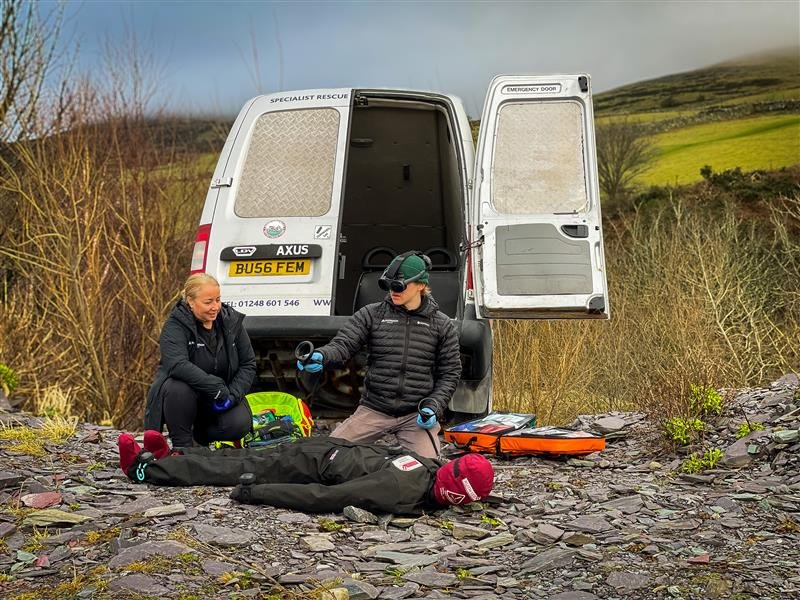
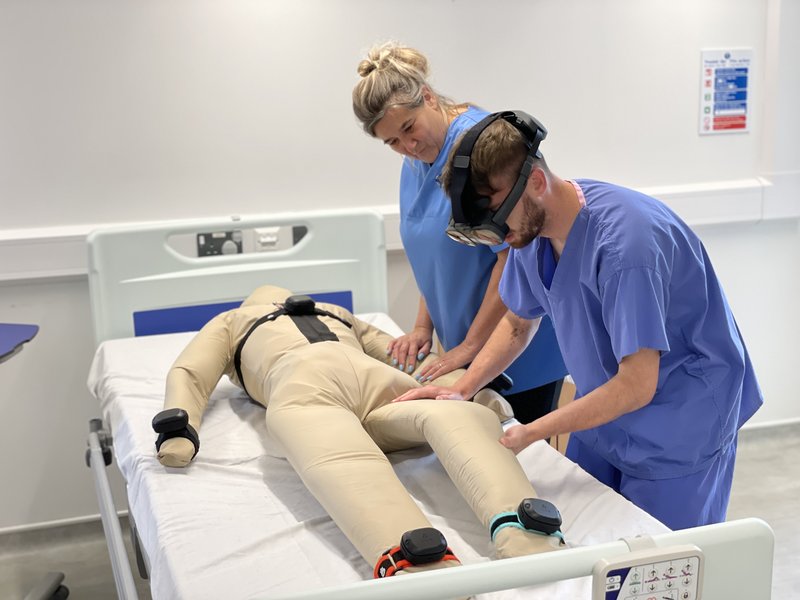
RL360 masterfully combines the realistic manual handling aspects of using weighted manikins with cutting-edge mixed reality (MR) technology. This provides trainees with a tactile and realistically weighted casualty as well as an immersive and accurate visual overlay. This combination guarantees the highest level of visual enhancement and feedback.
Additionally, the passthrough capabilities of the VIVE XR Elite headset and advanced self-tracking properties of the VIVE Ultimate Trackers allow trainees to interact with real-life props and environments. Rather than an entirely digital training experience, Ruth Lee has created an integrated solution that builds muscle memory and provides learning scenarios that feel real.
Another vital element of RL360 is the trainer, who brings industry knowledge and experience. Ruth Lee recognised that the human element could get lost in a digital solution, so they built in functionality that lets the trainer see exactly what the trainee sees through a TV or mobile device. This ensures that the expert guidance isn't replaced but rather enhanced.
Complex training enhanced with MR
As a result, expert trainers are able to give real-time feedback, and trainees can redo complex situations in a safe and controlled manner. The use of MR combined with the ability to cast and record trainee’s sessions is a fantastic way for trainers and peers to engage and discuss the skills covered in RL360 together— a challenge under traditional training methods. Utilising RL360 improves the quality of training trainees receive, allowing them to better perform with real-life casualties.
By using a system like RL360, training can be delivered much more quickly without the need to arrange for group sessions or outside contracts for training, reducing the time and cost it takes to train these skills effectively.
This MR solution is useful across all types of training but specifically for the types of scenarios that are traditionally difficult to teach in a realistic way due to danger and complexity. Ruth Lee has found specific applications with training for assessment of head injuries and traumatic bleeds as well as airway auscultation. The RL360 solution's MR elements make it possible to bring these complex scenarios to life, something that would be extremely difficult to replicate in real-life training.
The three-year journey from conception to completion was full of highs and lows, challenges and solutions. As with any technical product that is worth creating, Ruth Lee faced significant challenges that were not easy or even guaranteed to be overcome. We sat down with Product Manager Ryan Foley to hear more about why their partnership with HTC VIVE was such a game changer.
Ensuring quality passthrough
One of the most difficult elements to master was developing an MR solution with accurate and reliable passthrough. Passthrough uses external cameras to display a live view of the user’s physical surroundings on the headset's internal screens. Without this, the training would be limited to a 'closed' digital experience, removed from the real world.
As Product Manager Ryan Foley recounts, "Having good quality passthrough and accurate tracking in a hardware solution that would be commercially accessible for our customers proved a huge challenge in the early stages of our project."
Ruth Lee struggled to find a commercially focused solution that would achieve the tracking and passthrough functionality that was required. That was until they partnered with HTC VIVE and utilised its VIVE XR Elite headset and VIVE Ultimate Trackers. “This technology combined with the support of the HTC VIVE team allowed us to deliver on our idea and go to market in January 2025,” says Foley.
Thanks to industry-leading passthrough and groundbreaking MR features, Ruth Lee found the VIVE XR Elite - equipped with a 16 MP RGB camera, 4x tracking cameras and proximity sensors - to be superior to any alternatives on the market. They also appreciated the ability to utilise the headset with an external battery pack. This made it easy to use with the sorts of PPE their customers use during training.
All of this combined gave them confidence that the hardware could be used for the training they wanted to replicate. Better still, the price of HTC VIVE’s products meant that the whole package was also commercially viable. Not only did Ruth Lee find a product that had the technical capabilities they needed, but they also found something that would be affordable to their customers.
Solving the problem of accurate manikin tracking
As well as reliable passthrough, Ruth Lee’s product also required a way to accurately track their manikin. Without it, trainees wouldn’t be able to interact properly with the ‘patient’ in front of them. The solution needed to be accessible and easy for trainers with limited technical experience to deploy.
The first problem they encountered was that they quickly reached the limits of the headset they started development with. This, along with the lack of manufacturer support, meant they couldn’t continue.
The second problem was that they kept failing to develop a tracking solution for the manikins that would be usable with a commercial release. These two problems nearly led them to give up on the project entirely.
It was then that they discovered the VIVE Ultimate Trackers. Known for their accurate ‘self-tracking’ through onboard cameras and ability to be deployed even by those with limited technical exposure, they proved to be the perfect solution at a time when the whole project could have collapsed.
“The VIVE Ultimate Trackers were a huge breakthrough for us to deliver on our vision for RL360.” Foley continues, “The VIVE Wave SDK and its simple integration into Unity were also particularly helpful.”
Ruth Lee also appreciated how lightweight and compact the VIVE Ultimate Trackers proved to be, which made them ideal for training and deployment. The ability to utilise multiple trackers per headset also worked well with their training scenarios.
Finding a product that allowed them to track their manikins in real-time without the need for a PC or lightboxes was the moment they realised that RL360 was possible, and the project could be a commercial success.
Deploying RL360
Having overcome a number of challenges and developed a training solution that they were pleased with, it was now ready to test. Foley recounts that the standout experience for him was handling the manikin for the first time whilst utilising RL360. The combination of the tactile weight and shape of a Ruth Lee manikin combined with the realism provided by a MR overlay delivered a truly exceptional training experience.
Subsequent deployment of the RL360 in a real-world rescue environment proved the viability of the concept despite the limitations of confined spaces.
The HTC VIVE hardware has played a key role in enabling accessible, high-quality immersive experiences that resonate with frontline teams. The VIVE XR Elite headsets are lightweight and comfortable, even in dynamic situations, and intuitive to use. The success of the project also led to Ruth Lee being invited by the Welsh Government to share their development journey. This was part of the 50th Anniversary celebrations of the Knowledge Transfer Partnership (KTP) programme.
“Our first public demonstration of RL360 at the Emergency Services Show in 2024 was a huge moment for us; hearing the positive feedback and seeing the reactions to RL360 was a great way to end our KTP project,” says Foley.
The future of Mixed Reality training
The project has received highly positive feedback, with users consistently highlighting the realism, usability, and value it brings to emergency response training. There has been strong engagement and excitement from customers around the continued development of the platform, particularly the expansion of training scenarios.
The development of RL360 was a valuable experience for everyone at Ruth Lee, but for the team, this is only the beginning. By partnering with HTC VIVE, Ruth Lee hopes to explore further opportunities to develop new technology-focused solutions for emergency response training well into the future.